

This week’s Chart of the Week explores the relationship between market cap., liquidity, and valuation.
In the current capital-constrained environment, a logical hypothesis would be that valuation metrics should be higher for companies with more robust liquidity, as they have less apparent need for near-term capital raises. Similarly, the Valuation Gap graph in the Viridian Deal Tracker shows that larger cap companies consistently trade at high valuation multiples.
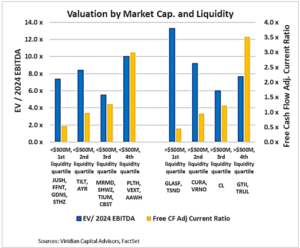
Viridian broke the twenty analyst-covered U.S. Cultivation and retail companies into those with less than $500M market cap on the left and those with more than $500M market cap on the right. We then further separated the companies in each size group into quartiles based on Viridian’s free cash flow adjusted current ratio, which modifies the standard current ratio to account for annualized free cash flow.
The blue bars (measured on the left axis) show median Enterprise Value/consensus 2024 EBITDA estimates. The yellow bars (measured on the right axis) show the median liquidity ratio.
As expected, the median EV/EBITDA ratio for the larger companies on the right was 8.86x, approximately 270 bp above the 6.16x multiple of the smaller companies.
Our intuition for the positive relationship between liquidity and valuation proves true for the under $500M group. The relationship is not perfect, but valuation ratios do rise as liquidity improves.
The relationship, however, is reversed in the larger cap group, with valuation metrics trending downward as liquidity increases. We found a similar reversal when we last explored this topic in the Viridian Chart of the Week on January 24, 2021. At that time, valuations were close to all-time highs; the large-cap group was trading at over 20x NTM EBITDA with unprecedented access to capital.
Check Out the Viridian Chart of the Week to See Our Full Analysis of EBITDA Multiples For the Top Public MSOs
About Viridian Capital Advisors, LLC
Launched in 2014, Viridian Capital Advisors was one of the first and now leading, corporate finance, advisory and M&A practices in the legal Cannabis/CBD industries, and now in the Psychedelics sector. We represent companies, investors, lenders, buyers and sellers. Our advisory practice is meant to help “institutionalize” our clients before they go to market for capital or M&A – by helping to build a professional Board of Directors, sophisticated financial models and valuation analyses, exit strategies and strategic advisory services. Our investment banking practice raises capital and executes M&A transactions through our New York City based broker-dealer, Bradley Woods & Co. Ltd.
Viridian is widely recognized as the industry leader in research and capital markets data/market intelligence through the Viridian Deal Tracker. Launched in January 2015, the Viridian Deal Tracker is a proprietary data service that monitors and analyzes investment, M&A activity and capital markets trends in the Cannabis, Hemp and Psychedelics industries. We’ve tracked and analyzed more than 6,500 transactions totaling more than $70 billion in transaction value. We know where equity investors invest, where lenders lend and where acquirers acquire. The Deal Tracker is received and read every day by thousands of leading industry players on a global basis, becoming a trusted and valuable source for companies, investors, lenders and sellers/acquirers to make informed capital allocation decisions.
Marijuana remains illegal under federal law. The federal government does not recognize marijuana to have any medicinal value. Marijuana cultivation, possession, consumption, sales, and distribution are illegal under federal laws and also certain state laws. Investors in cannabis may be subject to law enforcement actions. Please note that there are differences in marijuana laws from one state to another. Furthermore there are substantial risks associated with investing in cannabis companies, including, without limitation, changes in laws, rules, and regulations, risks associated with the economy, capital markets, and a company’s ability to execute on its business plan.