

January 2024: The Impact on Cash Flows from 280E is Massive. In January we affirmed our belief that rescheduling would happen and estimated that the top 10 companies alone would save over $700M annually from eliminating 280e and that the industry at large would save more than twice that amount.
January 2024: Reinvigoration of the Cannabis Capital Markets. For the last few months, we have been talking about the cannabis capital markets being frozen due to the uncertainty surrounding rescheduling. We reasoned that no CFO wanted to be “that guy” who raised equity at the bottom. We are now about to see the reversal of that process. Several companies have existing shelf registrations, and we expect companies to “average up” by doing small equity issues as prices continue to recover.
February 2024: M&A Activity Will Accelerate. M&A has been slow as companies conserve cash and focus on operating for profitability rather than growth. However, the valuation gap between large and small companies rebounded to 3.55 on the DEA news, the second highest it has been since May 2021 (the highest was 3.71 in 2/24). This gap will grow as the markets rally further, and it indicates a growing ability for the most prominent companies to complete accretive acquisitions. We predicted a resurgence of M&A at the beginning of the year, and finally, the catalyst has occurred.
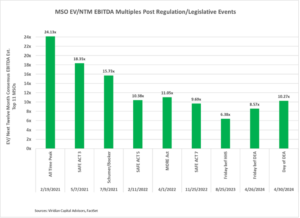
March 2024: There is Room to the Upside for Cannabis Stocks. The graph above shows the impact of past legislative/regulatory announcements on the trading multiples of cannabis companies. EV/NTM EBITDA multiples rose nearly 20% on Tuesday to 10.22x following the DEA news. But we believe that a much higher gain is in store. Specifically, we have been saying that we expect the market to rally beyond the 15.73x multiples from the Schumer/Booker proposal, possibly reaching the 18.35x achieved in May 2021 after the 5th House passage of the Safe Act.
Check Out the Full Viridian Insights of the Week for a Deeper Analysis Into the Impacts of Rescheduling
About Viridian Capital Advisors, LLC
Launched in 2014, Viridian Capital Advisors was one of the first and now leading, corporate finance, advisory and M&A practices in the legal Cannabis/CBD industries, and now in the Psychedelics sector. We represent companies, investors, lenders, buyers and sellers. Our advisory practice is meant to help “institutionalize” our clients before they go to market for capital or M&A – by helping to build a professional Board of Directors, sophisticated financial models and valuation analyses, exit strategies and strategic advisory services. Our investment banking practice raises capital and executes M&A transactions through our New York City based broker-dealer, Bradley Woods & Co. Ltd.
Viridian is widely recognized as the industry leader in research and capital markets data/market intelligence through the Viridian Deal Tracker. Launched in January 2015, the Viridian Deal Tracker is a proprietary data service that monitors and analyzes investment, M&A activity and capital markets trends in the Cannabis, Hemp and Psychedelics industries. We’ve tracked and analyzed more than 6,500 transactions totaling more than $70 billion in transaction value. We know where equity investors invest, where lenders lend and where acquirers acquire. The Deal Tracker is received and read every day by thousands of leading industry players on a global basis, becoming a trusted and valuable source for companies, investors, lenders and sellers/acquirers to make informed capital allocation decisions.
Marijuana remains illegal under federal law. The federal government does not recognize marijuana to have any medicinal value. Marijuana cultivation, possession, consumption, sales, and distribution are illegal under federal laws and also certain state laws. Investors in cannabis may be subject to law enforcement actions. Please note that there are differences in marijuana laws from one state to another. Furthermore there are substantial risks associated with investing in cannabis companies, including, without limitation, changes in laws, rules, and regulations, risks associated with the economy, capital markets, and a company’s ability to execute on its business plan.